
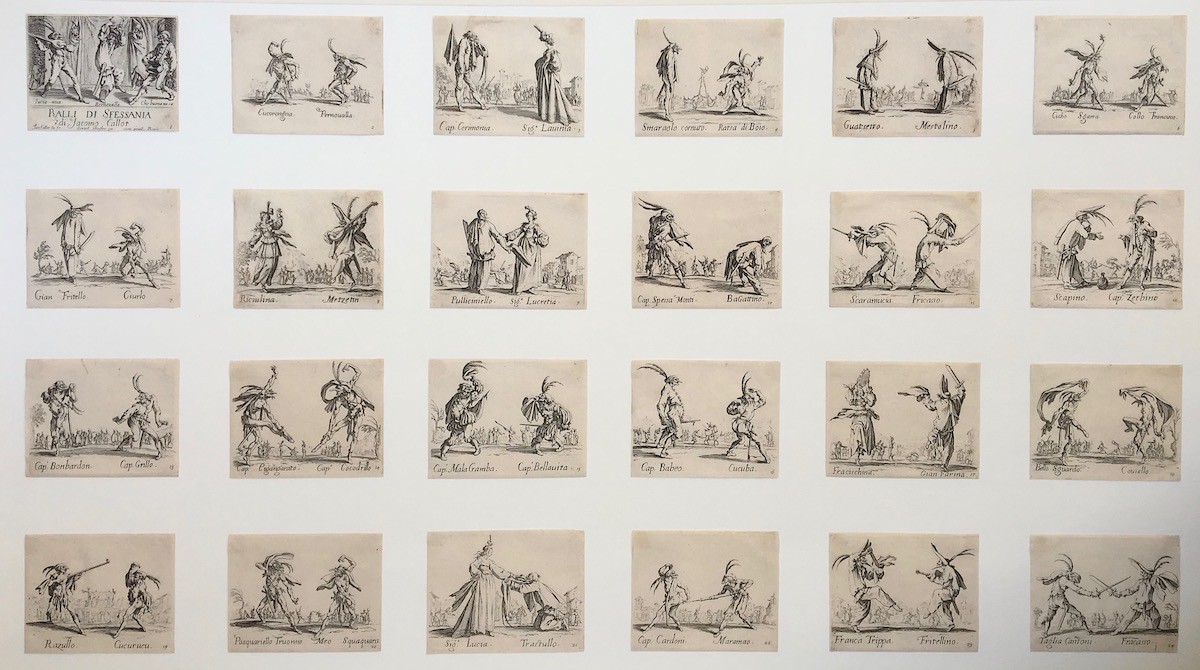
The portfolio dedicated is considered one of the most inventive works by the genius and master from Lorraine. Each plate presents a composition consisting of three perspective planes: the first with two figures taken from Italian comedy; the second, where a spectator is placed; the third, a landscape that helps to convey the horizon. The preparatory drawings, preserved in the British Museum, show the Master's difficulty in rendering the individual poses of each character harmonious and bizarre. Movement and theatricality are not lacking, as is usual in his work.
In the first half of the 17th century, Jacques Callot renewed the language of graphic art, developing and enhancing the potential of etching. Born in Nancy in 1592, he completed his artistic training in Italy, staying in Rome between 1608 and 1611. In the Italian capital, he learned to engrave with a burin and established his first contacts with the engraving community. Between 1612 and 1620, his patron was Cosimo II de' Medici, at whose court he gained great renown both as an engraver of refined skill and as an arbiter of taste and intelligence. His years in Florence were rich in works that established his fame: the series of Capricci di varie figure, the Intermezzi, La tentazione di Sant'Antonio and La Fiera dell'Impruneta, to mention only the most important.
After the death of Cosimo II in 1621, Callot returned to Nancy, where he had new illustrious patrons, including the Duke of Lorraine and the Infanta of Spain. During these same years, he produced the series of the Dances of Sfessania, the Hunchbacks, the Beggars of the Nobility and The Siege of Breda. His fame was finally established when he was commissioned by Richelieu to engrave the siege of La Rochelle for King Louis XIII of France.
In 1630, he began collaborating with the publisher Israël Henriet, who edited many of his works in Paris, including the successful series Les Misères de la Guerre (The Miseries of War), and remained the custodian of the plates after Callot's death in Nancy in 1635. Thanks to his inexhaustible inventiveness in his themes, his technical expertise and his attention to the minute and to detail, Callot's work stands as a decisive reference point for the entire history of European engraving.
Ref. 7015